
Food colours held to the purity rules of each market.
Synthetic food colours, their aluminium lakes and natural colours, sourced from qualified Indian manufacturers. The shade is the easy part. Each lot also has to pass the purity rules of the country where the food is sold.
See the example lot check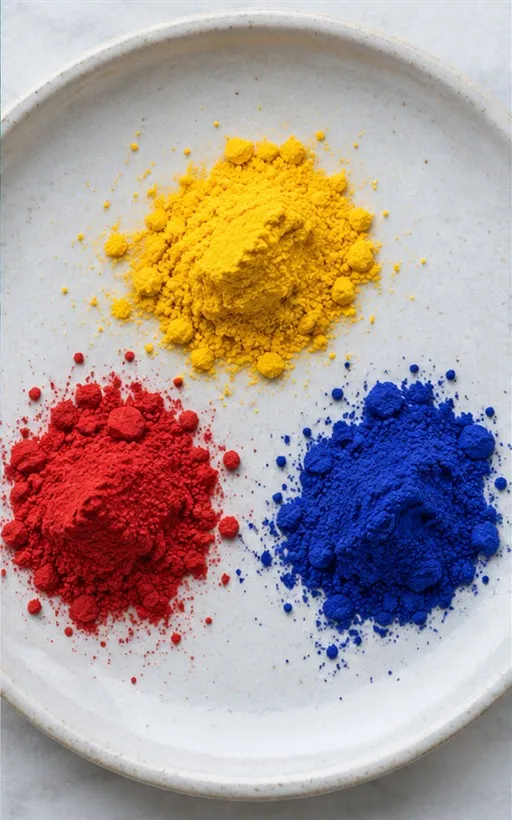
How we check a colour lot
- Shade
- Compare the lot with the approved swatch. The table shows this check.
- Purity
- Review the assay, subsidiary colours and applicable impurity limits separately.
| Sample | Standard | Lot | ΔE | Result |
|---|---|---|---|---|
| TartrazineE102 · FD&C Yellow 5 | 0.4 | Pass | ||
| Sunset Yellow FCFE110 · FD&C Yellow 6 | 0.7 | Pass | ||
| Ponceau 4RE124 | 1.7 | Hold | ||
| Brilliant Blue FCFE133 · FD&C Blue 1 | 0.3 | Pass |
Three product families, three behaviours.
| Family | What it is and where it fits | Watch for |
|---|---|---|
| Synthetic colours | Water-soluble, strong and stable, such as Tartrazine, Sunset Yellow FCF, Ponceau 4R, Carmoisine, Brilliant Blue FCF and Indigo Carmine. Beverages, confectionery, bakery and dairy. | Each market keeps its own permitted list, use limits and labelling rules. |
| Aluminium lakes | The same colours precipitated onto aluminium hydroxide, so they disperse instead of dissolving. Fat-based fillings, coatings, tablets and dry mixes. | Lake-specific limits on insoluble matter and on chlorides and sulphates, on top of the colour’s own purity criteria. |
| Natural colours | Curcumin, annatto, paprika, beta-carotene, anthocyanins and spirulina. Clean-label products and reformulation away from synthetic dyes. | More lot-to-lot variation, and sensitivity to pH, heat and light. |
One colour, three rulebooks.
A colour that is legal in one market can be restricted in another. Allura Red is used in the US and the EU but is not on India’s permitted list.
What a food colour lot is held to.
Natural colours behave like ingredients, not dyes.
Moving away from synthetic colours is mostly a stability problem. The answer is usually a trial in the buyer’s own product, not a substitution on paper.
What Nython checks before a food colour lot ships.
The same sequence as every other product. A dated, named technical opinion, not a certification.
Specify the market and the use
The destination markets, the food category, the form (dye, lake or natural) and the shade standard, written down before anyone quotes.
Qualify the maker
The plant, its food-safety licences and certifications, its raw materials and its batch records, not only a sample.
Hold each lot to the standard
The lot’s analysis against the purity criteria of each destination market and against your shade standard. For US-bound FD&C colours, the FDA certification lot number for the batch.
Food colours, in plain terms.
What is the difference between a food colour and an aluminium lake?
A food colour (dye) dissolves in water and colours by solution. A lake is the same colour precipitated onto aluminium hydroxide, so it does not dissolve and colours by dispersion. Lakes suit fat-based, dry and coated products, where a soluble dye would bleed or migrate.
Which synthetic food colours are permitted in India?
FSSAI permits eight synthetic colours: Ponceau 4R, Carmoisine, Erythrosine, Tartrazine, Sunset Yellow FCF, Indigo Carmine, Brilliant Blue FCF and Fast Green FCF, with maximum levels that depend on the food category. Check the current Food Products Standards and Food Additives Regulations, 2011 for the category you sell into.
What is FDA batch certification?
In the US, colours listed in 21 CFR part 74 (the FD&C colours) must be certified batch by batch. A sample of each batch goes to the FDA, which tests it against the specification and issues a certification lot number. Only certified batches can be sold for food use.
Which food colours need a warning label in the EU?
Foods containing Tartrazine (E102), Quinoline Yellow (E104), Sunset Yellow (E110), Carmoisine (E122), Ponceau 4R (E124) or Allura Red (E129) must carry a warning that the colour may have an adverse effect on activity and attention in children.
Are natural colours a drop-in replacement for synthetic ones?
Rarely. Natural colours vary more from lot to lot and react to pH, heat and light in ways synthetic colours do not. Anthocyanins shift from red toward purple and blue as pH rises, and spirulina blue fades with heat. Plan a trial in your own product before switching.
Does Nython certify food colours?
No. Nython gives a technical opinion on whether a lot matches the specification you approved and the purity standard of your market. It does not replace FDA certification, an accredited laboratory analysis, or the manufacturer’s own regulatory obligations.
Where the rules come from.
- US FDA, Color additives in foods, and 21 CFR part 80, colour additive certification.
- US FDA, tracking industry pledges to remove petroleum-based food dyes.
- EU warning labels: CMS legal update on compulsory warnings on colours.
- India: FSSAI Food Products Standards and Food Additives Regulations, 2011, Appendix A. Limits vary by food category and change by amendment, so check the current text.